The West is Losing
Part 1 - Taiwan
Author: Allen Lee, AI researcher and former military drone operator; former chief of staff to a Taiwan Air Force commander who later became Secretary of Defense.
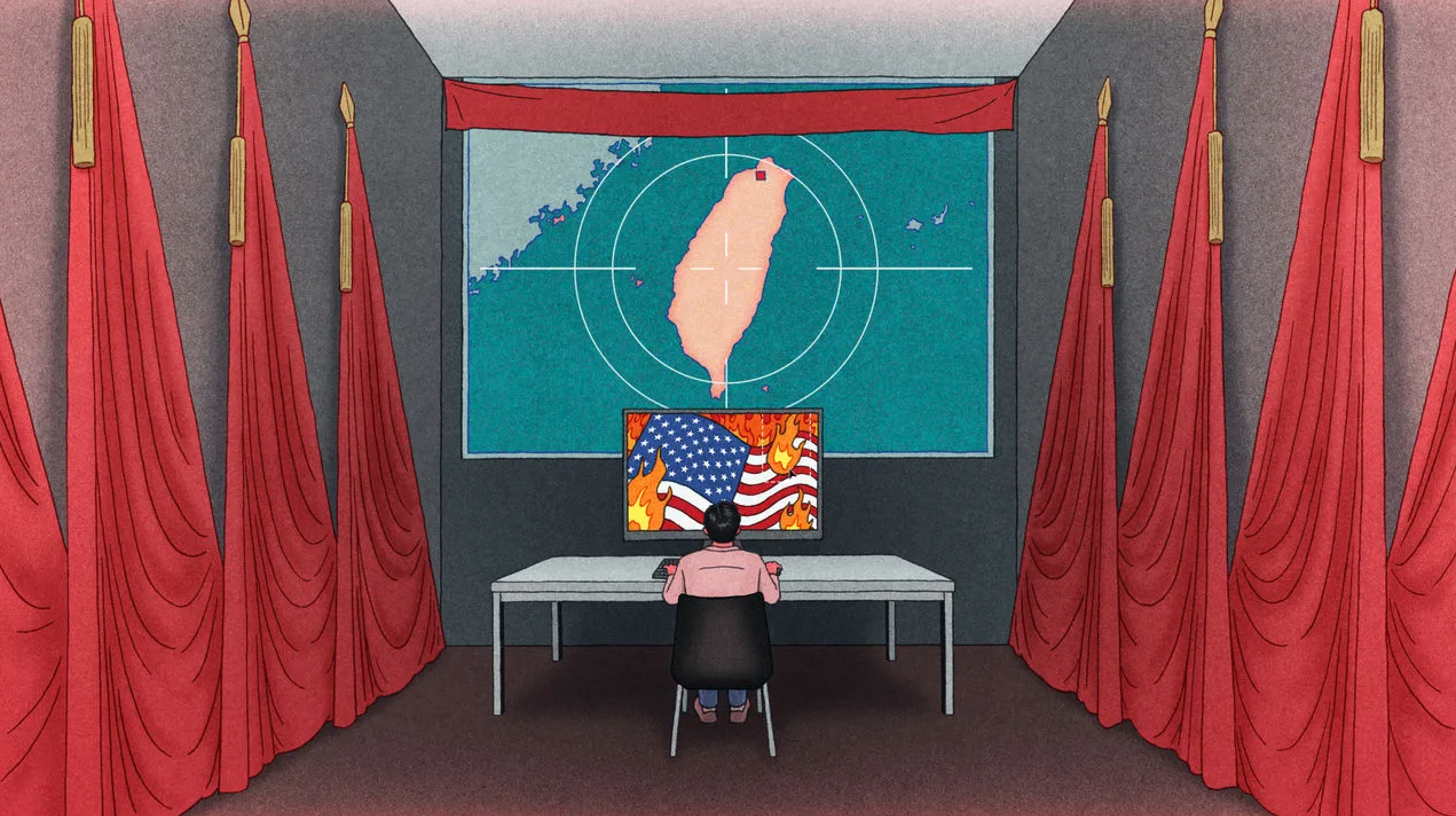
The next war over Taiwan probably won’t be decided by stealth fighters, aircraft carriers, or even missiles.
It will be decided by spreadsheets.
That sounds absurd until you look at Ukraine.
A country can now destroy a multi-million-dollar air-defense system with a drone assembled from commercially available parts. A Shahed drone costs maybe tens of thousands of dollars. A Patriot interceptor costs several million. One side spends Toyota money. The other side spends mansion money.
The important thing is not the exact ratio. The important thing is that modern air defense is drifting into a fundamentally losing business model.
For decades, the West assumed technological superiority would compensate for smaller numbers. That assumption worked when precision weapons were rare and difficult to build. It works less well when autonomy, cheap sensors, and commodity manufacturing start scaling together.
Taiwan is where this reality becomes unavoidable.
Taiwan’s Real Problem
Most discussions about Taiwan still revolve around the wrong variables.
People talk about whether the United States would intervene. They talk about naval blockades, semiconductor fabs, amphibious landings, alliance commitments, and escalation ladders.
Those things matter.
But before any of that, there is a more basic question:
Can Taiwan sustain the economics of defense longer than China can sustain the economics of attack?
Right now the answer is uncomfortable.
Patriot interceptors are already scarce. The United States is trying to rebuild its own stockpiles (till 2030 maybe?) while supporting Europe, maintaining commitments in the Middle East, and preparing for future contingencies in the Pacific. Europe is also restocking.
There is no hidden warehouse full of surplus interceptors waiting for Taiwan.
Even if Washington wanted to rapidly arm Taiwan at scale, the industrial base is not configured for it.
Beijing understands this perfectly.
China does not need to openly threaten every country supporting Taiwan. It rarely has to. Economic gravity does most of the work automatically. Governments worry about market access. Corporations worry about retaliation. Investors worry about instability.
So Taiwan waits.
The United States and Europe replenish themselves first. Taiwan gets what remains afterward.
This matters because a real conflict probably would not begin with dramatic scenes of fighter jets dogfighting over the Strait. China’s opening move is more likely to look industrial than cinematic: thousands of cheap drones, loitering munitions, decoys, and missiles designed to overload radars and exhaust inventories.
The goal is not immediate destruction.
The goal is to force Taiwan into spending expensive defensive assets faster than they can be replaced.This is the core asymmetry.
China can manufacture attrition.
Taiwan cannot.
China’s Advantages Are Deeper Than People Think
Western analysis often frames China’s advantage as quantitative: more ships, more missiles, more drones.
But the deeper advantage is structural.
China’s political system, industrial base, and military doctrine are all increasingly aligned around the economics of autonomous warfare.
The West still treats drones as supplements.
China and Russia increasingly treats them as infrastructure.
Different Civilizations, Different Constraints
The first asymmetry is political.
Western democracies place real limits on autonomous weapons. Civilian casualties generate public backlash. Legal reviews slow deployment. Alliance politics complicate operational decisions.
This is not irrational. Liberal societies are supposed to care about these things.
But it creates friction.
China and Russia operate with far fewer constraints. They tolerate more experimentation, more operational risk, and more ambiguity around civilian harm.
In practical terms, this means they iterate faster.
Every battlefield becomes a feedback loop.
The West still tends to think about military procurement in multi-year cycles. Autonomous warfare evolves closer to software culture: rapid deployment, constant updates, continuous adaptation.
The side willing to absorb more chaos often learns faster.
AI Matters More Than Fighter Jets
The second asymmetry is computational.
Washington’s export controls on advanced chips make sense, but there is a strange contradiction at the center of current Western policy.
The United States understands that AI is strategically decisive.
What it still does not fully understand is that AI becomes geopolitically relevant only when it is fused with industrial capacity.
A drone swarm does not need GPT-9.
It needs reliable ai navigation, targeting, coordination, sensor fusion, and the ability to adapt from battlefield data.
Most of these on-device ai systems can run on far less compute than people assume.
China’s advantage is not necessarily frontier models. The advantage is integration.
Beijing can connect manufacturing, data collection, software iteration, and deployment into one continuous pipeline. Western democracies still separate these functions across contractors, agencies, procurement offices, and regulatory systems.
The result is slower adaptation. And in autonomous warfare, slow adaptation is lethal.
Manufacturing Is Destiny
The third asymmetry is industrial.
China already dominates much of the world’s commercial drone brand and the drone supply chain. Batteries, motors, sensors, radio modules, low-cost assembly — the infrastructure already exists.
People still underestimate how important this is.
Modern drone warfare rewards scale more than perfection.
Cheap systems that are “good enough” and produced endlessly often outperform exquisite systems built in limited quantities.
The West still thinks like an aerospace industry.
China increasingly thinks like a consumer electronics industry.
That distinction matters.
Consumer electronics culture optimizes for iteration speed, supply-chain density, and manufacturing scale. Those are exactly the characteristics autonomous warfare now rewards.
Taiwan is trapped in the middle.
It has extraordinary engineering talent and genuine startup innovation, but it does not have China’s manufacturing depth. So it remains dependent on Western supply chains that move too slowly and cost too much.
Over time the economics become brutal.
China loses cheap drones and learns from the losses.
Taiwan loses expensive interceptors and becomes weaker.
One side gains data through attrition.
The other loses inventory.
What the West Still Does Not Want to Admit
The uncomfortable reality is that the West may already be conceptually behind.
American defense culture still revolves around preserving high-value platforms.
But autonomous warfare changes the equation. The future battlefield rewards systems that are expendable, decentralized, adaptive, and mass-produced.
The logic starts looking less like traditional aerospace and more like network infrastructure.
Taiwan’s survival probably depends on understanding this faster than its adversaries do.
That means accepting a different model of defense:
Cheap autonomous systems at massive scale.
Distributed manufacturing.
Rapid software iteration.
Smarter on-device ai fine-tuning.
Resilient communications.
Local production.
Inventory depth over platform prestige.
The sophisticated part of the force should exist primarily in sensing, coordination, networking, and AI integration — not necessarily in the individual drone itself.
This also requires a political decision in Washington.
If Taiwan continues to be treated mainly as a delayed foreign military sale, the underlying industrial imbalance will continue widening every year.
At some point the issue stops being military.
It becomes civilizational.
The real question is whether liberal democracies can still organize industrial power at the speed modern conflict requires.
China believes the answer is no.
Taiwan may become the place where that assumption gets tested.
I’m always happy to discuss these ideas further — feel free to email me at allenleexyz@gmail.com.